x

What should I know about multi-level marketing schemes?

Have you ever been invited to a business deal, asked to sell a product, work from home and earn a huge commission? How did you respond to it? Did you know that this could be a multi-level marketing scheme? Remember to always be careful about posts we see on social media even if they are from trusted friends or family members. Always be wary of the risks that this may bring you once you start to engage.

Multi-level marketing may not be a bad thing at all BUT it is best to know it carefully and ask the following questions:

  • Are you being asked to ‘invest’ a large amount of money up front to become a distributor? This request can also be disguised as an inventory charge. Legitimate multi-level marketing businesses do not ask for large start up costs.

  • If you do have to pay for inventory, will the company buy back any unsold inventory from you? Legitimate multi-level marketing companies will offer and stick to inventory buy-backs for at least 80% of what you paid.

  • Is there any mention of a market for the product or service? Multi-level marketing depends on establishing a market for the company's products. If the company doesn't seem to have any interest in consumer demand for its products, that’s a red flag - don't sign up.

  • Is there more emphasis placed on recruitment than on selling the product or service? The difference between multilevel marketing and a pyramid scheme is in the focus. The pyramid scheme focuses on fast profits from signing people up and getting their money. If recruitment seems to be the focus of the plan, then do not sign up for this company.

Understand what the focus of the company is by asking yourself:

  • Is the plan designed so that you make more money by recruiting new members rather than through sales that you make yourself? This is the signature of a pyramid scheme operation, not a multi-level marketing scheme.

  • Are you offered commissions for recruiting new members? This is another sign of a pyramid scheme. It's the number of people who are willing to sign up that matters in a pyramid scheme, not the products or services being offered.

Always be very cautious before investing in any scheme and never borrow money or take out a loan for investment purposes. Money for investments should be any extra money you may have that you do not need to use in the short term. Never invest more than you can afford to lose.

(Points sourced from: The Balance - Susan Ward)

What are ponzi schemes? How can I avoid these scams when investing?

Ponzi schemes and investment scams should be avoided at all costs. Here are some ways to understand and identify them.

A Ponzi scheme is an illegal investment scheme. Earlier investors are paid with so-called “returns” from the money that newer investors contribute. 

Organisers of Ponzi schemes often trick new investors by promising investment opportunities that generate high returns with little or no risk (Risk = the chances of losing your money to an investment). Investors may be asked to bring in a certain number of new investors in order to take part in the investment. Often, family and friends are drawn into take part in the scheme. They contribute money which they believe will be invested in a company, but is actually used to pay earlier investors as ‘returns’.

Identify the following Red Flags to avoid getting scammed:

  • Red Flag #1. Low risk and high returns

There is no ‘guaranteed’ investment opportunity. Every investment is risky and higher returns usually involve more risk. If an investment pays back regular, positive returns despite overall market conditions, it may be too good to be true. Investment values tend to go up and down over time, especially those with the potential for high returns.

Ask yourself: Do I understand the risk involved compared to the potential return?

  • Red Flag #2. Lack of understanding of the investment/company

The key to protecting oneself from investment scams is to avoid investments you do not understand or for which you cannot get complete information. Ponzi schemes are typically not registered with government regulators and involve unlicensed individuals or unregistered firms. Registration is important because it provides investors with access to key information about the company’s management, products, services and finances. Never accept the claim that you cannot review information about an investment in writing.

Ask yourself: Do I have enough information about the company? Do I have access to information and understand the investment fully?

  • Red Flag #3. Recruitment of friends and relatives

Victims of pyramid schemes are often required to recruit others into the scheme. The money from the later investors, their friends and relatives, are used by the organisers to stand as the ‘profits’ from the so-called investment. Eventually, the pyramid schemers will flee with the accrued funds.

Ask yourself: Do I understand the risks of recruiting friends and relatives? Is there a clear explanation how returns are calculated?

  • Red Flag #4. Difficulty receiving payments

Pyramid scheme organisers often encourage investors to “roll over” investments and promise higher returns. Be suspicious if you have difficulty cashing out or receiving payments on your investment.

Ask yourself: Is there a systematic process regarding how investors can cash out investments at anytime? Do I know who or where to go to for help if anything goes wrong with the investment scheme?

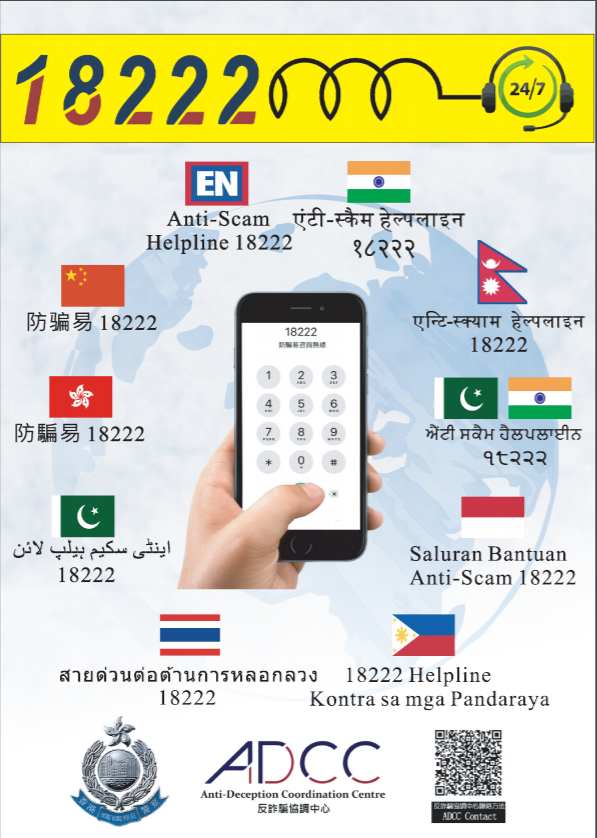
If you suspect something is a scam, even if you’re unsure, call 18222, the 24-hour hotline of the Anti-Deception Coordination Centre, Hong Kong Police, who can give you more guidance.

Also, attend our Growing My Money workshop to learn more about how to spot investment scams and invest safely.

I want my earnings to grow. How do I decide where to invest my money?

Investing involves different risk levels. The higher the interest and rate of return, the higher the risk.

Make sure you fully understand the investment opportunity and the associated risk before deciding to make any investment (Risk = the chances of losing your money to an investment).  

There is no single best type of investment for everyone. You have to understand your risk appetite (the level of risk you can and are willing to take) before you invest your money, and also know the purpose of your investment - is it for the short term, medium term or long term? Watch out for scams - if the interest rate offered to you sounds too good to be true, it’s probably not true. 

Do not attempt to borrow money or take out a loan for investment purposes. Money for investments should be any extra money you may have that you do not need to use in the short term. Never invest more than you can afford to lose.

Attend our Growing My Money workshop to learn about different investment tools and how to invest safely.

What is the difference between a borrower, guarantor, reference and witness?

Before you sign any loan contract - whether it is for your own loan or for a friend’s loan - always read the contract very, very carefully and make sure you understand exactly what your role and obligations are. Here is a simple explanation of what some of the roles might be: 

Borrower: The person who is borrowing money from a bank, money lender or financial institution. Typically, the borrower signs a contract and agrees to certain repayment terms. This person might also be known as the ‘principal borrower’, meaning the person who has borrowed the ‘principal’ or main loan amount.

Guarantor: If you are a guarantor on someone else’s loan, you are promising to the lender that you will repay the borrower’s loan if the borrower does not repay. If you sign as a guarantor on a loan contract, that is legally binding. Only agree to be a guarantor if you can afford the risk. 

Reference: A reference is considered to be just an introduction to the borrower, like a character reference. Referees should not be subject to what is written in the legal agreement. There should not be any obligation to repay someone else’s loan just by being a referee. If you are a referee and have not signed as a guarantor, and if you are being contacted to repay someone else’s loan as though you were a guarantor, you can be very clear and say that you have no legal obligation to pay. 

Witness: Technically, a ‘witness’ is meant to provide confirmation that a contract or transaction has taken place; for a loan contract, a ‘witness’ should not be expected to pay the loan amount  if the borrower cannot repay the loan. However in Hong Kong, money lenders often illegally use the term ‘witness’ in Bahasa Indonesia to refer to either a ‘guarantor’ or ‘reference’. Be cautious of signing a loan that uses this term. Before signing, clarify exactly what the obligations are - specifically whether you will be accountable to pay the loan if the borrower cannot. Be cautious of agreeing to be a ‘witness’ on the phone. If you have not signed someone else’s loan as a guarantor, you are not legally obliged to repay it as a ‘reference’ or ‘witness’.

I’m being harassed by a loan shark/collecting agent! What do I do?

If the behaviour is violent or potentially a threat to you or your employer, report the loan shark/collecting agent to the Hong Kong Police (999).

Remember to keep calm and do not let insults or threats put you down.

Contact us immediately for a free confidential one-to-one financial counselling session to receive impartial financial advice. Our counsellors speak English, Tagalog or Bahasa Indonesia. We do not lend money. We only provide neutral advice. You do not have to deal with this on your own. Seek help as soon as possible.

If you feel comfortable, and if your employer is open to it, you could have an open conversation with your employer about your financial plans and difficulties, including your goals, debts or worries. It may be difficult for you to open up to your employer about your financial difficulties but doing so now can prevent a bigger issue from occurring if the loan shark/collecting agent contacts them. If the agent contacts your employer first, they might understandably be scared and misunderstand the situation. Be open and honest with your employer. Assure them that you are seeking a solution so that you can continue to focus on your work and not be distracted by stress. This might help clear any misunderstanding and also help them feel more comfortable in communicating with you about this issue. 

How do I know if the interest rate I am being offered on my loan is legal?

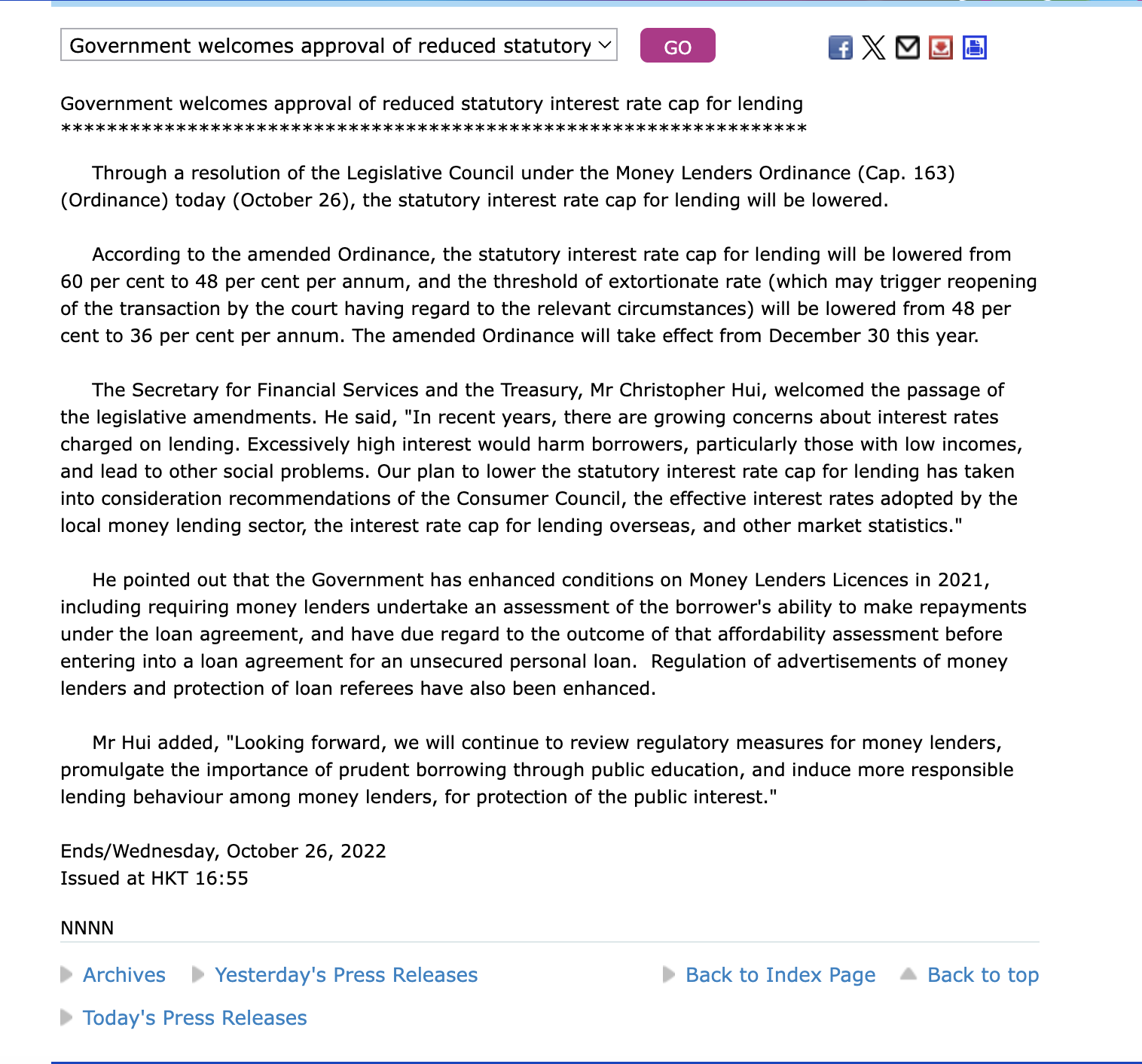
According to Hong Kong law (The Money Lenders Ordinance), a loan with an effective interest rate that exceeds 36% per year is presumed to be extortionate. This means that before a court will enforce repayment of the loan, the lender must prove that charging such a high interest is not unfair or unreasonable. Loans with interest rates above 48% are illegal.

The following types of fees are also illegal and, if charged, the loan cannot be enforced: 

  • fees for processing or establishing your loan;

  • most types of late charges.

If in doubt, contact us for a free confidential one-to-one financial counselling session to receive impartial financial advice. You can seek legal advice from charities HELP for Domestic Workers or Mission for Migrant Workers, or visit a district office of the Duty Lawyer Service for free legal support.

My friend has asked me to sign as a ‘guarantor’ for her loan. Should I sign?

It’s understandable that you might want to help your friend, especially if she needs the money urgently or has helped you a lot in the past. However, it is okay to say ‘no’ to friends sometimes if it means protecting your hard-earned money. 

We do not advise you to sign a loan for your friend as a guarantor - this means that you are agreeing to repay the loan amount if your friend is unable to pay and defaults on the loan. Only take this risk if you can afford it.

These are some points to consider before signing as a guarantor:

  • Are you able to pay someone else’s debt if that person defaults (i.e. does not pay) on that loan?

  • Do not sign as a guarantor unless you know who the document is for and how much money you are agreeing to pay.

  • Exercise extreme caution before agreeing to pay “all moneys” owed by the borrower because if they default, you will have to pay everything the borrower owes (including interest).

Make sure you also understand the obligations of agreeing to be a ‘witness’ or a ‘referee’, even if you’re not a guarantor. Ask what this entails. Some unethical lending agencies will try to hold you accountable as a guarantor even if you have only agreed to be a witness/referee. 

Attend our Money and Family workshop to learn about how to have difficult conversations with family and friends, and how to say ‘no’ when needed.

The money lender is asking to keep my passport as security. Is this allowed?

The following cannot be taken as security for a loan:

  • HKID card;

  • passport;

  • national ID card;

  • bank savings or account book; or

  • photographs of you, your guarantor or your family.

No one is allowed to keep your passport except for you and the authorities. If you have given any of these items as security/collateral, ask the money lender to return them immediately. If they refuse, contact the Hong Kong Police (999) and your consulate.

You can call the Indonesian Consulate at +852 6773 0466 or the Philippine Consulate at +852 9155 4023.

What do I do if I think I have signed a bad loan contract?

If you think you may have signed an illegal or extortionate loan agreement you may consider taking some (or all) of the following steps:

  • Attempt to renegotiate it with the money lender, pointing out that it is extortionate or illegal.

  • Lodge a complaint with the Hong Kong Police Money Lenders Unit at +852 2860 3574.

  • Seek legal advice. You can contact charities HELP for Domestic Workers or Mission for Migrant Workers, or visit a district office of the Duty Lawyer Service for free legal support.

If I really need a loan, where can I go?

First, identify and understand what you need the money for. Make sure it is for something very important and that you are able to meet your repayment obligations. Here are some points to consider when deciding where to borrow money:

Loan Company/ Money Lenders

If you do feel you definitely have to take out a loan, explore several options and choose a loan company which you feel comfortable with and which offers you fair terms. We encourage you to consider lending from an ethical source. Do not borrow from unlicensed money lenders as that can leave you unprotected and vulnerable.

As much as possible, avoid getting into a cycle of debt and make sure you are protected. Before signing a loan, first ask yourself:

  • Is the loan for a ‘need’ or a ‘want’?

  • Is the lender licensed? Unlicensed money lenders give illegal loan terms.

  • Will I receive certified documents (e.g. contracts, receipts, statements) for my records?

  • Do I understand the loan terms? Can I afford the monthly repayment and the late payment fees?

  • Will the lender keep my passport? It is illegal for anyone to do this except for me and the authorities.

Speak to your employer

If possible, talk to your employer first before taking out a loan. Explain what the loan is for and let them know you are thinking of borrowing from an agency. If they are open to it and can afford it, you could ask for a salary advance and arrange legal payment terms with them rather than taking out a loan with an agency or friends. This can help to avoid the very high interest rates that loan companies (and sometimes friends) will charge. If you come to an arrangement with your employer, be sure to put it in writing and to honour your side of the agreement. Note that loan repayment to your employer cannot legally be automatically deducted from your salary and needs to take place in a separate transaction between you and your employer.

Friends, relatives or individuals

We do not advise you to borrow money from friends, relatives or other individuals as this can you leave you unprotected and vulnerable. Similarly, we do not advise you to sign a loan for your friend or relative as a guarantor - this means that you are agreeing to repay the loan amount if your friend is unable to pay and defaults on the loan. Only take this risk if you can afford it.

Subscribe to
Whatsapp Whatsapp